Is solar actually worth it for you?
No salesperson. No pressure. Just your own numbers. Type in your power bill, pick how much you think rates will rise, and see what staying with the utility really costs you over 30 years.
What doing nothing costs you
Your power bill isn't standing still. Between rate changes, fees, taxes, and fuel charges, the all-in cost of electricity has climbed year after year for decades. Put in your average bill and the yearly increase you expect, and watch what happens.
What you hand the power company each year
Each bar is one year. The shaded top of each bar is the increase — money you only pay because you waited.
Year-by-year breakdown
| Year | Monthly bill | That year's total | Running total |
|---|
Here's the part nobody tells you
Over 30 years, a properly designed solar system makes the same electricity you'd buy from the power company — for roughly half the price. And that's comparing it to today's frozen rates. Compare it to your bill with increases, and solar can land near one-fifth of what you'd otherwise hand the utility.
Real example: a $164 average bill is $59,040 over 30 years even if rates never move. A typical single-story, roof-mounted system to cover that usage runs around $25,000 — less than half. Against a bill rising 5% a year (about $130,000 over 30 years), that same $25,000 is roughly 19%. You're buying 30 years of power once, instead of renting it forever at a rising price.
Compare it to solar
Have a solar quote? Drop it in and see how it stacks up against doing nothing. Don't have one yet? Pick the last option and we'll show you a typical example.
Total paid out, year by year
Everything you've spent up to that point. Where the lines cross is the day solar became the cheaper decision.
Straight answers to fair questions
What should I put for the rate increase?
It's a trickier question than it sounds. Ask Google and you'll get different answers depending on when and how you ask, and pin it to Florida and you'll get a whole range. Part of the reason: some answers only count the increase in the rate per kWh, while others fold in fees, taxes, and fuel charges too. What actually matters to you is how much your total electric expense climbs each year — the whole bill, not just one line on it. Some years the rate dips, other years it jumps, but over time the total bill has typically netted around 5% a year. We use 5% to stay on the conservative side. With everything going on in the world right now, plenty of experts expect the increases to run higher than that.
Why measure over 30 years?
Two reasons. Most panels are warrantied to still produce at 90%+ after 30 years, and most solar loans run 25–30 years. It's the honest window to compare a one-time purchase against a lifetime of rising bills.
Can you really promise these numbers?
No — and anyone who promises an exact figure is selling you. These numbers assume a typical install of top-tier components: single-story, roof-mounted on a shingle roof, no batteries. Your price can shift with a tile or metal roof, a ground mount, premium equipment, or added battery backup. Any of those can raise the cost — but none of them raise it past what the power company will charge you over 30 years. Not by miles. The only way to get your exact number is to look at your roof and your usage, which is exactly why the quote is free.
What about maintenance and parts wearing out?
Panels need cleaning once or twice a year — usually a trip fee plus about $10 a panel. The inverter (the brain of the system) typically gets replaced somewhere around year 12–15. And panels slowly lose a little output over time, down to roughly 90% by year 30. We left those out of the calculators above to keep them simple — but even after you fold every one of them in, the total still comes in far under a lifetime of utility bills. That's the whole point.
Will they survive a hurricane, and what about my roof?
Two fair Florida questions. On wind: quality panels and racking are engineered and permitted to your local wind code — in much of Florida that means rated well past 150 mph, and many components carry Miami-Dade product approval, the toughest standard in the country. They're anchored down far better than most people assume. On your roof: a proper install flashes and seals every penetration so it won't leak. A sloppy one is a different story — which is exactly why who you hire matters. The one real cost to plan for: if your roof is near the end of its life, replace it before you go solar. Otherwise, when the shingles wear out years down the road, you'll pay to remove and reset the panels to reroof. We check your roof's age and condition up front and tell you straight if it should come first.
What if we don't stay in the house 30 years?
Most people don't. Solar tends to sell with the home — a buyer choosing between two houses, one with a power bill and one without, picks the one without. You can sometimes move a system, but it's often not worth the cost. Either way, you stop renting your electricity in the meantime.
Will my power bill go to zero?
The consumption portion of your bill can, with a properly sized solar system. But the power company still charges a connection fee on any grid-tied solar — typically $30 to $40 a month. Most solar customers choose to stay grid-tied anyway: it covers cloudy days and nighttime, and it saves you from a pricey battery upgrade.
What if net metering ends in Florida?
With some smaller Florida utilities, it already has. The big three — Duke, FPL, and TECO — have tried to end it and may try again. Net metering is the arrangement where your power company credits you the same rate for the power you send to the grid as they charge you for the power you pull from it. So if you use 1,000 kWh a month and your solar produces 1,000 kWh a month, the consumption portion of your bill nets to zero. If that arrangement ends, the utility may pay you less for what you produce than it charges for what you use. Should that be, or become, the situation with your power company, the solution is batteries — you store your own production and use it yourself instead of selling it back at a discount.
If the grid goes down, does my solar keep working?
With a standard grid-tied system, no — it shuts off with everyone else's power, for safety. If backup during outages matters to you, that's a battery system, which costs more. Tell your rep and they'll design for it. We'd rather you know this up front than find out during a storm. And even with a battery added, your solar quote will still come in tens of thousands of dollars below your cost to do nothing.
What about the federal tax credit?
Be careful here, because this changed. The 30% federal credit for buying a home solar system ended December 31, 2025 — a system purchased in 2026 or later doesn't qualify. The one remaining federal path is third-party ownership (a lease or power-purchase agreement), which can still qualify through 2027 — but there's usually an escalator, and the company gets the credit, not you. We don't recommend them, ever. Anybody still promising you a 30% purchase credit today either hasn't kept up or is hoping you haven't. Ask us and we'll tell you exactly what does and doesn't apply right now.
So is there any incentive left at all?
Yes — just not the federal purchase credit. Florida still exempts your solar equipment from the state's 6% sales tax, so you don't pay tax on the panels, inverter, racking, or batteries. And under Florida's property-tax exemption, the value solar adds to your home is left out of your assessed value — your house is worth more, but your property tax bill doesn't go up because of it. Both are automatic: no application, no waiting list, no funding cap, and they're written into state law well into the future. So while the "government pays you to go solar" pitch is nonsense, these two are real, current, and yours.
Isn't solar "free," or doesn't the government pay me to install it?
That's clickbait, usually from lead brokers who collect your info and sell it to a dozen contractors until your phone won't stop ringing. Solar isn't free — you're redirecting money you already spend on power into owning your own. That's a good deal, but it's not free, and we're not going to insult you by pretending otherwise. Any relationship that starts with a lie tends to follow with more lies. Avoid this.
Watch out for hidden "dealer fees" on solar loans.
This is the one the industry hopes you never learn. Most solar loans with a low advertised rate — "just 2.99%!" — quietly bake in a dealer fee, often 15% to 30% of the system price, to buy that rate down. So a system that's $25,000 in cash can show up as a $32,000-plus loan, and you pay interest on the padding. It's legal, it's everywhere, and it's why a cash price and a financed price can be wildly different for the exact same equipment. Always ask for the cash price and the dealer fee in writing, and run both through the calculator above. A fair company will show you both without flinching.
A contractor quoted me the same size system as my neighbor's. Good sign?
Run. A system should be sized to your roof and your usage. One-size-fits-all quotes are how people end up with a solar payment and a power bill. Nobody should quote you without knowing what you actually use.
Will my HOA stop me?
In Florida, they can't. Solar is a protected home improvement under the Florida Solar Rights Act — an HOA isn't allowed to prohibit it.
What should I look for in a contractor?
Longevity, reputation, and intent. There are a lot of moving parts in a solar install, and you want a contractor who'll be around for decades in case you need service or maintenance. If their previous customers have nice things to say about them, you probably will too. And if they keep their word, show up when they say they will, keep you in the loop, and do all the things that signal good intentions, you can count on them to be there if anything goes wrong. This matters more than price, location, brands, incentives, or anything else.
Should I go solar?
People have many different reasons to go solar. Some want to save the world, some want to increase the value of their home, some need backup if the grid fails, and there are many more. For us, those are all great reasons — but the one that should make it easy for everyone is the financial math. It costs less to make your own than it does to buy it from your power company. Yes, you should probably go solar.
So who put this together?
A Central Florida solar contractor built this page for the curious — people who want to run the numbers themselves without a high-pressure rep breathing down their neck. The whole industry has a reputation for exactly that, and we get why you'd want to keep your distance.
The calculator only knows the numbers you type in — it can't see who installs your system, and that part matters. A fair price and a proper install are what let you keep the full difference. Pay too much for gear you don't need, or too little to a bargain outfit that cuts corners and leaves the job half-finished, and you give some of it back. The math is forgiving enough that even a bad deal still beats doing nothing — but why hand any of it away? That's exactly why who you choose matters, and exactly why we built this. If you've read this far and you'd like a real number done right, here's the honest offer:
You're in Central Florida and want a quote
We're an established local company — in business since 1999, with real reviews and a focus on doing right by the customer. We'll design a system to your actual home and usage, price it, and tell you straight whether it makes sense. If it costs more than staying with the utility, we'll tell you not to buy it.
Not ready for that yet
Fair enough. Grab our free buyer's guide and get educated first — how solar actually works, what to watch out for, and the questions to ask before anyone quotes you a dime. No sales call required.
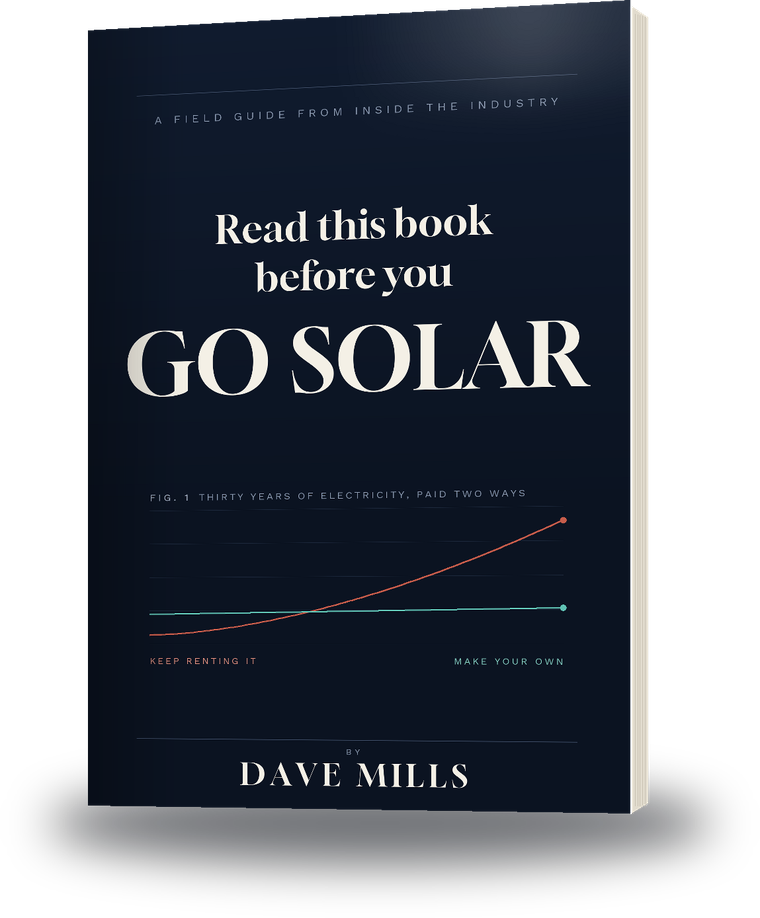
Read This Book Before You Go Solar
Written by someone inside the industry, for people who are tired of being sold to. It's the stuff a good contractor would tell you over a kitchen table — and the stuff a bad one hopes you never ask about.
- How solar actually works, in plain English
- The dealer-fee trap hiding inside "low rate" solar loans
- The questions to ask before anyone quotes you a dime
- How to spot a contractor who'll still be around in ten years
Free estimate or free book — your call
We are not a lead broker. Your information stays with us and is never sold. You'll hear from one honest company, once.
Brought to you by AllSolar Energy — serving Central Florida since 1999. The numbers only work when the system is priced fairly and installed right; if you'd like a quote done that way, we're here.
4205 St. Johns Parkway, Sanford, FL 32771 · (866) 412-4218 · License #CVC056660 #EC13005027
Figures shown are estimates based on your inputs and a typical installation. Your actual costs and savings depend on your home, roof, usage, equipment, and financing. Not a guarantee. Ask for a written estimate.